August 10, 2026 · Money
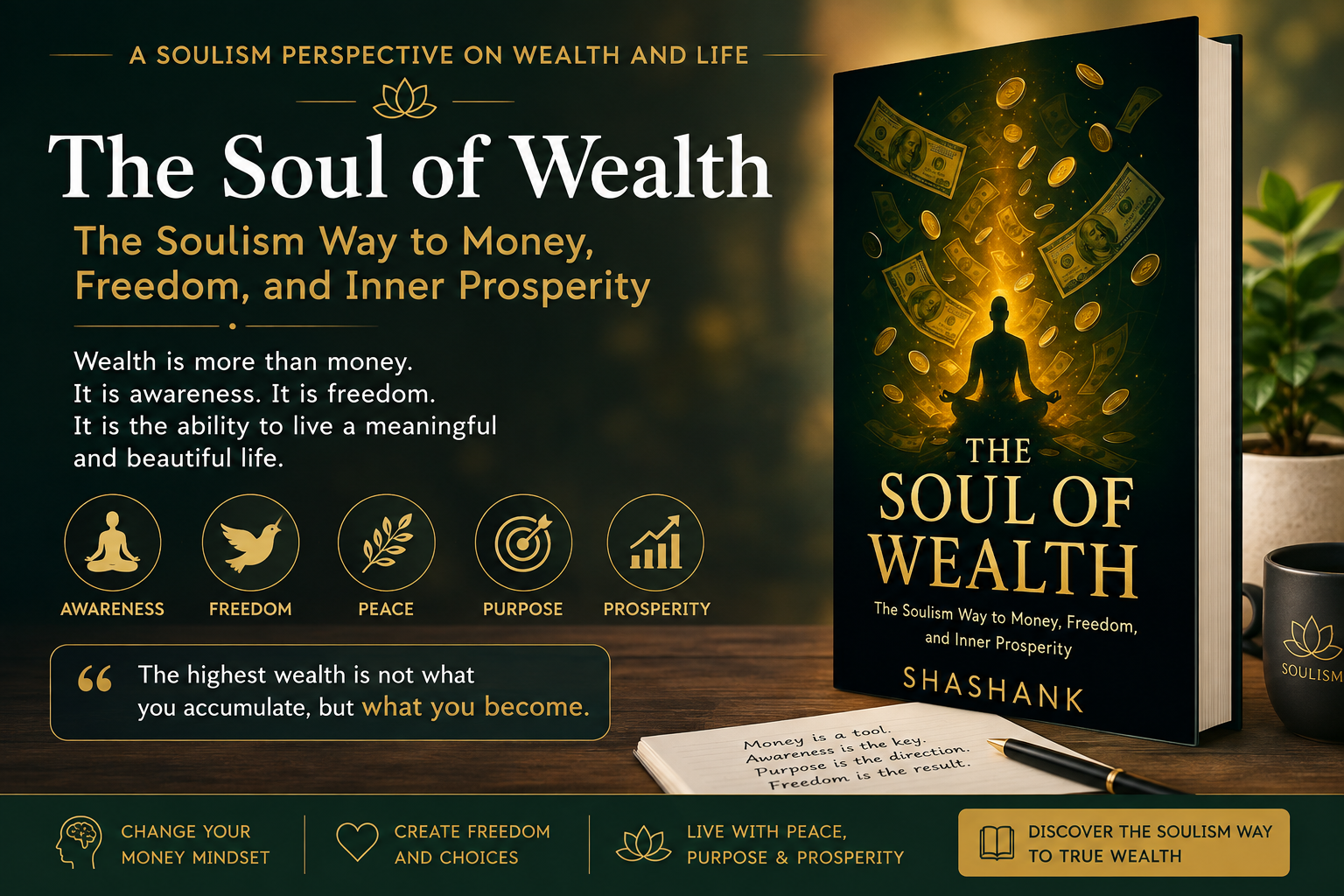
The Soul of Wealth: The Soulism Way to Money, Freedom, and Inner Prosperity
A Soulism perspective on money, freedom, conscious wealth, and a richer inner life
What if true wealth is not only about how much money you have, but about how consciously you live?
The Soul of Wealth explores a different relationship with money—one based on awareness, freedom, purpose, peace, and inner prosperity.
The Soul of Wealth explores a different relationship with money—one based on awareness, freedom, purpose, peace, and inner prosperity.
Money can provide security, opportunity, comfort, and freedom. But money can also become a source of fear, comparison, pressure, guilt, and endless dissatisfaction.
This is where Soulism offers a different perspective. Rather than treating financial success as the final destination, Soulism asks us to examine the awareness behind our financial choices.
Why do we want more money? What does money mean to us? Are our financial decisions driven by clarity or fear? And can wealth actually help us create a more meaningful and beautiful life?
These are some of the deeper questions explored in The Soul of Wealth: The Soulism Way to Money, Freedom, and Inner Prosperity.
“The highest wealth is not what you accumulate, but what you become.”
In This Article
- Why Do We Feel Guilty About Wealth?
- Is Money Good or Bad?
- The Connection Between Awareness and Wealth
- How Fear Influences Financial Decisions
- What Is Conscious Wealth?
- Why Wealth Should Create Freedom
- Skills, Self-Trust and Financial Freedom
- Wealth, Flow and Alignment
- Wealth, Peace and Purpose
- The Soulism Vision of a Beautiful Life
1. Why Do We Feel Guilty About Wealth?
Many people want financial freedom while simultaneously feeling uncomfortable with the idea of becoming wealthy.
These feelings can sometimes come from ideas absorbed during childhood. People may hear messages such as “money changes people,” “rich people are selfish,” or “money is not important.”
Over time, such messages can become invisible beliefs that influence financial decisions.
The issue is not necessarily money itself. The deeper issue is the emotional meaning we attach to money.
When wealth becomes associated with guilt, people may hesitate to pursue opportunities, feel uncomfortable asking for fair compensation, or believe that wanting financial success is somehow wrong.
Soulism approaches these patterns through awareness rather than self-judgment. The first step is simply to notice the belief and question where it came from.
Ask yourself:
What did I learn about money before I was old enough to question it?
2. Is Money Good or Bad?
Soulism does not treat money as inherently good or inherently bad.
Money is a tool. How it is earned, used, shared, saved, and invested matters—but money itself does not automatically determine a person's character.
The relationship a person has with money can reveal deeper concerns about security, identity, freedom, comparison, control, and desire.
“Money is a tool. Awareness determines how we use it.”
This distinction separates wealth from identity. A person's financial position does not determine their human worth.
Someone can have significant wealth and still experience anxiety. Another person can have modest financial resources while experiencing gratitude, clarity, and peace.
The goal is therefore not simply to have more. The goal is to develop a conscious relationship with what you have and what you want to create.
3. The Connection Between Awareness and Wealth
One of Soulism's central ideas is that awareness should guide action.
Financial decisions are rarely purely mathematical. Behind saving, spending, earning, investing, and taking risks there are often emotions, habits, assumptions, and beliefs.
Two people can receive exactly the same financial opportunity and respond completely differently. One may see possibility. Another may immediately see danger.
The external opportunity may be identical. The internal interpretation is different.
Soulism therefore encourages us to observe our internal state before making important decisions.
Before making an important financial decision, ask:
Am I acting from clarity or fear?
Am I trying to create something—or escape something?
Does this decision support the life I actually want?
Am I trying to create something—or escape something?
Does this decision support the life I actually want?
4. How Fear Influences Financial Decisions
Fear does not always stop us from taking action. Sometimes it quietly changes the direction of our action.
We may remain in a familiar job because uncertainty feels frightening. We may postpone a decision because we fear making a mistake. We may avoid asking for fair compensation because we fear rejection or judgment.
These decisions can look responsible from the outside. But internally, they may be driven more by fear than conscious choice.
“Fear does not always stop action. Sometimes it redirects it.”
Soulism does not ask us to eliminate fear. It asks us to understand fear before allowing it to control our choices.
The objective is not reckless courage. The objective is conscious clarity.
5. What Is Conscious Wealth?
Conscious wealth is one of the central ideas in the Soulism approach to money.
Unconscious wealth can become driven by comparison, status, validation, or the endless feeling that more is required.
Conscious wealth begins with different questions.
- How much is actually enough for the life I want?
- Does my money increase my freedom?
- Does my lifestyle support my peace?
- Am I earning in a way that aligns with my values?
- Can I enjoy abundance without allowing it to define my identity?
The Soulism approach treats wealth as something that should be integrated into life rather than placed above life.
The purpose of wealth is not to become wealth's servant. The purpose is to allow resources to support a meaningful life.
6. Why Wealth Should Create Freedom
Financial freedom is often misunderstood as simply having a very large amount of money.
Soulism offers a broader perspective: freedom is the ability to make conscious choices.
Money can create freedom when it gives us greater control over our time, choices, and circumstances.
But wealth can also become another form of pressure when lifestyle grows faster than awareness.
A person may earn more money but become trapped by higher expenses, greater expectations, status competition, and the constant need to maintain an image.
“Freedom is not excess. It is choice.”
This is why Soulism does not equate luxury with freedom. A person can own expensive things and still feel trapped. Another person can live simply and possess a remarkable degree of freedom.
7. Skills, Self-Trust and Financial Freedom
Money is not the only financial asset. Capability is an asset too.
Skills create options. Options create flexibility. Flexibility can reduce dependence and increase confidence.
Knowledge tells us what something is. Skill develops when knowledge is applied through practice.
Developing useful skills can therefore become another form of wealth—the wealth of being able to respond to changing circumstances.
A useful Soulism question:
What skill could I develop today that would give my future self more freedom?
8. Wealth, Flow and Alignment
Another important idea in the Soulism approach is flow.
Soulism distinguishes flow from constant hustle. Hustle can be driven by urgency, pressure, and the belief that stopping means falling behind.
Flow is different. It is associated with clarity, presence, meaningful action, and trust in a process that is aligned with your direction.
A useful Soulism model for flow includes three elements:
- Clarity of direction
- Presence in action
- Trust in the process
When these elements come together, work, learning, creativity, and financial decisions can become less reactive and more intentional.
“Speed exhausts. Rhythm sustains.”
9. Wealth, Peace and Purpose
The deeper argument of The Soul of Wealth is not that money is the highest achievement.
Instead, the book explores how wealth, peace, freedom, and purpose can exist together.
If wealth exists without peace, pressure can grow. If peace exists without purpose, life can become stagnant. If purpose exists without practical resources, frustration can appear.
Soulism therefore seeks integration rather than separation.
Financial life, inner life, relationships, growth, and meaningful direction can support one another.
“True prosperity begins when wealth supports the life you value.”
10. The Soulism Vision of a Beautiful Life
Ultimately, Soulism does not ask you to choose between money and meaning. It asks you to create a conscious relationship between them.
Wealth can support freedom. Freedom can create space. Space can create awareness. Awareness can improve decisions. Better decisions can create healthier relationships with work, money, and life.
The goal is not unlimited accumulation. It is conscious prosperity.
A beautiful life is one in which money has a proper place. It provides support without becoming identity. It creates options without creating obsession. It enables contribution without demanding that money become the meaning of life.
From the Soulism perspective, the deepest form of wealth is therefore not simply what you possess. It is the quality of awareness with which you live.
“The highest wealth is not what you accumulate, but what you become.”
Why Read The Soul of Wealth?
The Soul of Wealth: The Soulism Way to Money, Freedom, and Inner Prosperity is for readers who want to think about money differently.
It is not simply a book about earning more money. It explores the deeper relationship between wealth, awareness, fear, freedom, peace, purpose, and personal growth.
The book asks questions that go beyond conventional financial advice:
- What does money actually mean to me?
- Am I pursuing wealth from freedom or fear?
- How much is enough?
- Can financial success coexist with inner peace?
- Can money support purpose without becoming purpose?
- What does true prosperity actually mean?
If you are interested in Soulism, conscious living, financial freedom, wealth psychology, personal growth, inner peace, purpose, and meaningful living, this book offers a philosophical framework for exploring these questions together.
Most importantly, the book does not ask you to accept every idea blindly. It invites you to examine your own experience, question inherited beliefs, and discover what a genuinely prosperous life means to you.
📖 Get the Book
Discover the Soulism way to money, freedom, and inner prosperity.
Buy The Soul of Wealth on Amazon